
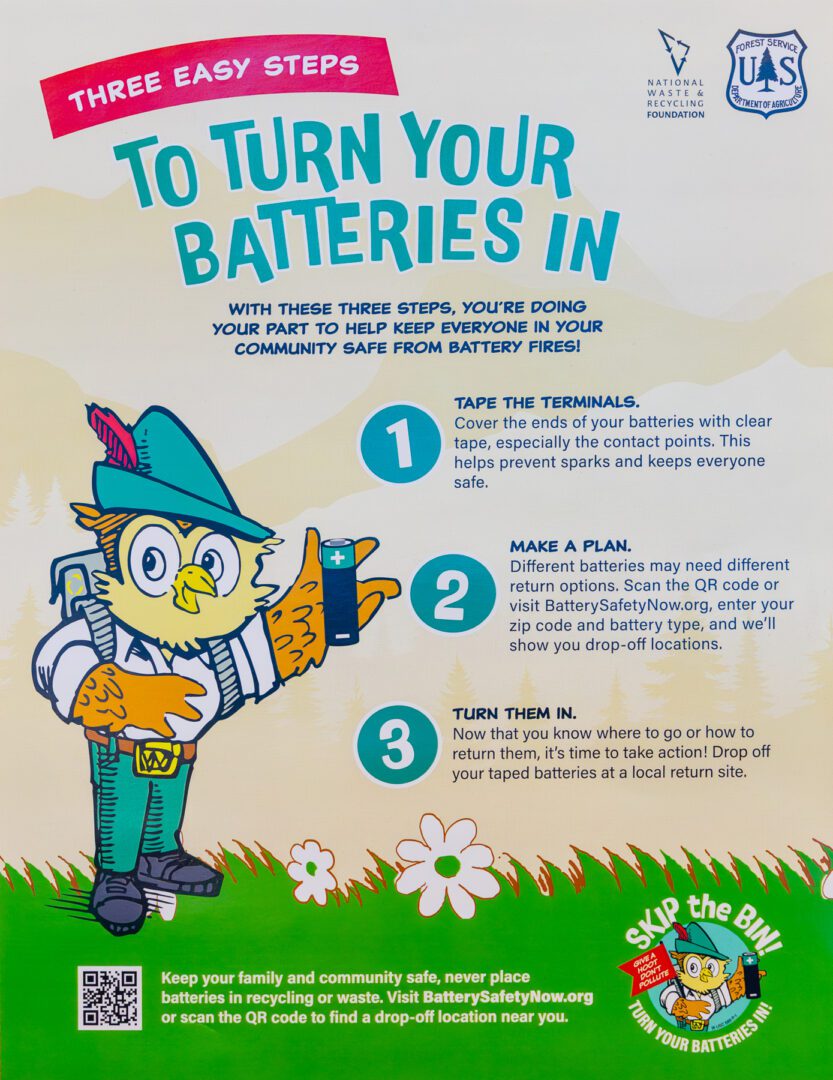
Battery Safety
There once was once a time, hopefully long ago, where we threw our old, dead batteries into the trash. These included batteries for flashlights, toys, radios and more. These discarded batteries poisoned our landfills with toxic substances, and could spark intense fires that were very difficult to stop.
These days batteries are the primary source of power or backup power for an ever-increasing variety of electronics devices, which makes their safe and responsible disposal even more important. At this year’s CES (the Consumer Electronics Show) in Las Vegas, one of the many exhibits there was for BatterySafetyNow.org. In their custom “Skip the Bin! Turn your batteries in!” travel trailer, “Woodsy Owl” has been travelling across the U.S. to educate communities about safe battery disposal. “Woodsy Owl” reminds us that “everyone has an important part to play in keeping our homes, families, and communities safe.”

We were reminded that today, batteries power our laptops, smartphones, power tools, e-scooters, remote controls, smoke detectors, many children’s toys and even singing greeting cards.
Batteries can store an immense amount of energy in a very small space, but when a battery gets too hot or comes under too much pressure, it can trigger a scientific process called “thermal runaway.” Thermal runaway is a self-sustaining chain reaction where a little bit of pressure or heat starts producing even more heat, leading to a rapid rise in temperature that can trigger deadly fires or explosions. When a battery overheats, it can jump from 212°F to 1,800°F in a second—and produce flames as hot as 2,000 °F (source: https://news.clemson.edu/lithium-ion-battery-fires-are-a-growing-public-safety-concern-%E2%88%92-heres-how-to-reduce-the-risk/).

Furthermore, as lithium battery fires burn, they release toxic gasses like hydrogen fluoride and carbon monoxide. If inhaled, these fumes can lead to trouble breathing, eye and skin irritation, and in some cases, even death.
Battery fires don’t just burn hotter—they burn longer, too. These fires are extremely difficult for firefighters to put out, and they can quickly reignite without a moment’s notice.
In our homes, if we throw batteries into the trash, they can overheat or get crushed, causing these fires. If batteries are placed in curbside recycling or trash bins, they can overheat or get crushed inside the collection trucks — often while these trucks are in motion. This creates a serious fire risk, endangering the lives of sanitation workers and threatening nearby homes, vehicles and our neighborhoods.

If batteries end up at waste and non-battery recycling facilities, they pose a serious fire hazard to workers and equipment. Facilities across the U.S. report over 5,000 fires each year — many sparked by improperly disposed batteries. These incidents cause millions of dollars in damage, disrupt essential services and put lives at risk (source: https://wasterecycling.org/wp-content/uploads/2024/07/RRS-Lithium-battery-one-pager-final.pdf).
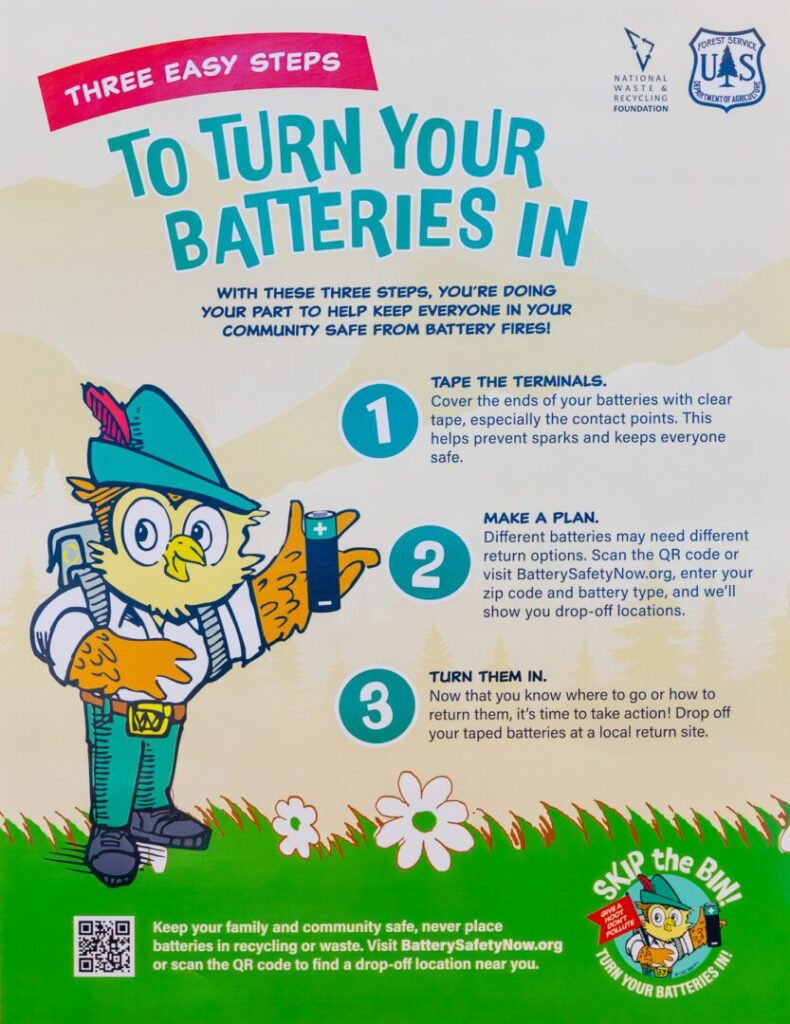
Here is what you can do. When it is time to dispose of your batteries, never throw them in the trash or in a recycling bin. Instead, turn them in safely to a drop-off location that will send them to a safe battery recycling center. Here is a link to where you can locate recycling centers for primary (single-use) batteries, E-bike batteries, cellphone batteries, high-energy batteries, damaged/defective batteries and rechargeable batteries: https://locator.batterynetwork.org.
To learn more about battery safety and what you can do, visit: batterysafetynow.org. There, in addition to the battery recycling center locator and a contact page where you can ask questions, you will find many resources, including a listing of upcoming events across the country — and a sign-up form if you are interested in hosting your own community’s battery take-back event with “Woodsy Owl;” and even a “Kids’ Corner,” with downloadable, printable kids’ activities and where there are reminders for kids to use only the charger that comes with their devices; to not throw or drop devices that contain batteries, since that can be dangerous; to stop using devices containing batteries and tell adults if those devices are swollen, cracked or leaking; to ask adults to help replace batteries; to learn how to prepare batteries for safe disposal (tape the ends) and find a drop-off location; and to NEVER, EVER throw batteries into the trash or a recycling bin.
To explore a wide variety of content dating back to 2002, with the most photos and the latest text, visit “AutoMatters & More” at https://automatters.net. Search by title or topic in the Search Bar in the middle of the Home Page, or click on the blue ‘years’ boxes and browse.
Jan, this is good advice. I have recycled batteries for 35 years, since I moved to the USA. I was fortunate that, from day one, my waste disposal company supplied me with a packet of bright orange plastic bags for used battery disposal. When an orange bag is full, I just place it on top of my green bin on the street. It’s that easy.
David
David,
It’s good to see that you’ve been recycling batteries for so long.
I put mine in a gallon-sized baggie. I put a strip of electrical tape across the positive terminal of each battery, to prevent short circuits.
Jan